How to Develop a Strong Thesis Statement for Any Essay
A thesis statement is the backbone of your essay. It tells your reader exactly what you’re arguing and why it matters. Without a strong one, even the best research can fall flat. The good news? You don’t need to be a professional writer to craft a clear, persuasive thesis. Whether you’re working on a high school persuasive paper or a college research essay, this guide will show you how to write a strong thesis statement that sets your argument up for success.
A strong thesis statement is a single sentence that presents your main argument and sets up the entire essay. It should be specific, debatable, and focused. To write one, start with a question, take a clear position, add your reasoning, and refine for clarity. Avoid vague language and broad claims. Use this guide to turn a weak thesis into a powerful foundation for your academic writing and boost your essay grades. This method works for any essay type.
What Makes a Thesis Statement Strong?
A thesis statement is not a fact, a summary, or a question. It is an argument that requires evidence. Strong thesis statements share three core qualities:
- Specific: It narrows down a broad topic into a focused claim.
- Debatable: Someone could reasonably disagree with it.
- Focused: It covers one main idea, not several.
If your thesis is too vague or too broad, your essay will wander. A tight thesis keeps you on track and shows your reader you have a clear plan.
How to Write a Strong Thesis Statement Step by Step
Follow these steps to build a thesis that can carry your entire essay.
-
Start with a research question. Ask yourself: What problem or issue am I trying to address? For example, “Should college athletes be paid?” This question gives you a direction.
-
Take a clear position. Your thesis must state your stance. Do not sit on the fence. Instead of “There are arguments for and against paying college athletes,” say “College athletes should be compensated for their labor because they generate billions in revenue for universities.”
-
Add your main reasoning. The strongest essays preview the key points that support your claim. In the above example, the reasoning is baked into the “because” clause. This lets the reader know what evidence to expect.
-
Make it specific. Replace vague words with concrete terms. Instead of “Social media is harmful,” try “Excessive use of Instagram correlates with higher rates of anxiety and body dissatisfaction among teenage girls.”
-
Check for debatability. If your thesis is a statement of fact (“The sky is blue”), it’s not a thesis. If it’s something a thoughtful person could challenge, you’re on the right track.
-
Refine the language. Cut unnecessary words. Make sure every word earns its place. A strong thesis is concise.
Common Mistakes to Avoid (and How to Fix Them)
Many students fall into the same traps. Here is a table of the most common thesis statement mistakes and what to do instead.
| Mistake | Problem | Fix |
|---|---|---|
| Vague thesis: “Technology is changing our lives.” | Too broad; doesn’t say how or why. | Narrow it: “The rise of remote work technologies has permanently shifted expectations around work life balance for office employees.” |
| Statement of fact: “The Civil War started in 1861.” | Not debatable; no argument. | Turn it into an interpretation: “The primary cause of the Civil War was not economic policy but the national debate over slavery’s expansion.” |
| Thesis as a question: “Should we ban plastic bags?” | A question cannot be argued; it’s open ended. | Convert to a claim: “Plastic bags should be banned because they pollute oceans and take centuries to decompose.” |
| Multiple ideas: “Climate change is caused by humans and also leads to more natural disasters, and the government should do something.” | Too many arguments; no focus. | Pick one claim and stick to it: “Human activity is the dominant cause of recent climate change, as shown by carbon emission data and temperature records.” |
| Overly simplistic: “School uniforms are good.” | No depth or reasoning. | Add nuance: “School uniforms reduce socioeconomic tension in middle schools, leading to fewer bullying incidents and higher academic focus.” |
Real Examples: Weak vs. Strong Thesis Statements
Seeing the difference in action makes the concept click.
Weak: “Recycling is important for the environment.”
Strong: “Implementing mandatory curbside recycling in all U.S. cities would reduce landfill waste by 30% within five years and lower municipal waste management costs.”
Weak: “This essay will discuss the pros and cons of social media.”
Strong: “While social media connects people across distances, its addictive design undermines real world relationships and should be regulated like other public health risks.”
Weak: “The Great Gatsby is a novel about the American Dream.”
Strong: “In The Great Gatsby, Fitzgerald argues that the American Dream is an illusion that corrupts those who chase it, as seen through Gatsby’s tragic pursuit of Daisy.”
Notice how each strong thesis takes a specific stand and gives a preview of the evidence. That’s the formula.
Expert Advice to Strengthen Your Thesis
“A common mistake students make is trying to prove too much. A strong thesis does not try to cover the whole world. It covers one argument and covers it well. If you find yourself writing ‘and’ or ‘also’ in your thesis, you probably have two ideas fighting for space. Cut one and save it for another essay.” — Dr. Mariana Torres, Writing Center Director, University of Texas.
That advice is gold. Keep your thesis simple and your evidence rich.
How to Know When Your Thesis Is Ready
Before you start writing the body paragraphs, test your thesis against these three questions:
- Is it arguable? (Would someone disagree?)
- Is it specific? (Could you sum up the main points from it?)
- Does it guide the structure? (Will each body paragraph support this one sentence?)
If you can answer yes to all three, you’re ready. If not, spend a few more minutes sharpening it. A little extra effort here saves hours of rewriting later.
Tying It Together with Your Essay
Your thesis is not a standalone sentence. It must connect to every paragraph. As you write, check each paragraph against your thesis. Does it support your claim? Does it add evidence or reasoning? If a paragraph drifts away, move it to a different essay or cut it.
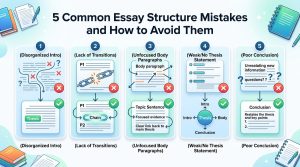
Many students find that common essay writing mistakes happen because the thesis was weak from the start. By fixing the thesis first, you solve a lot of problems before they appear.
If you’re working on a persuasive paper, you might also benefit from learning how to build a persuasive argument in your essay. A strong thesis is only half the battle; you need solid reasoning to back it up.
For those who want extra help, 5 research-backed techniques to strengthen your essay thesis in 2026 offers a deeper look at advanced strategies.
Your Turn: Practice Makes Perfect
The best way to get better at writing thesis statements is to practice. Take any topic you’re studying and write three different thesis statements for it. Then pick the strongest one and explain why. Do this once a week, and you’ll notice a huge difference in your essay quality.
Writing a strong thesis statement is a skill. Like any skill, it improves with repetition. Use the steps and examples here as your guide. The next time you sit down to write an essay, you’ll know exactly where to start.
Where to Go from Here
You now have a clear method to write a thesis statement that works. Use it on your next assignment. If you get stuck, come back to this page. Think of it as your personal writing coach.
And if you want to strengthen your overall essay writing, check out our guide to effective techniques to craft compelling academic essays. A great thesis needs a great essay around it.
Start writing. Your strongest argument is waiting.